
Coming back from a five-week volunteering trip in Tanzania, I came across an old article by Teju
Cole critiquing Western volunteering as a big emotional experience that validates privilege. As I
reflected on the impact I had – or hadn’t – made, I began to question: Had I, too, become an
accomplice in the “white-saviour complex”?
I’ve long been aware of the business behind voluntourism: expensive packages that combine
tourism and charity, designed to make the volunteer feel more comfortable rather than genuinely
helping the local community. Hoping to avoid these pitfalls, I chose to spend June and July
volunteering with a small, local NGO called Samaritan Volunteers.
Founded by Emmanuel Peter in 2018, Samaritan Volunteers operates in Chamazi, 30 km from Dar
es Salaam. Despite being the most densely populated area in Tanzania, the region lacks essential
services such as running water, stable electricity, and adequate healthcare facilities, and has only
two public schools.
Fresh out of university with a degree in computer science, Emmanuel launched his project with a
simple yet impactful goal: to give young people access to computers and teach them basic software
skills like Microsoft Office (Word, Excel, and PowerPoint). “These skills could help secure better
jobs in Chamazi’s unstable economy, where most families rely on small businesses for income,”
Emmanuel explained. However, due to a lack of funding, the project shut down. However, his
commitment to the neighbourhood didn’t end there. He assembled a team of local teachers and
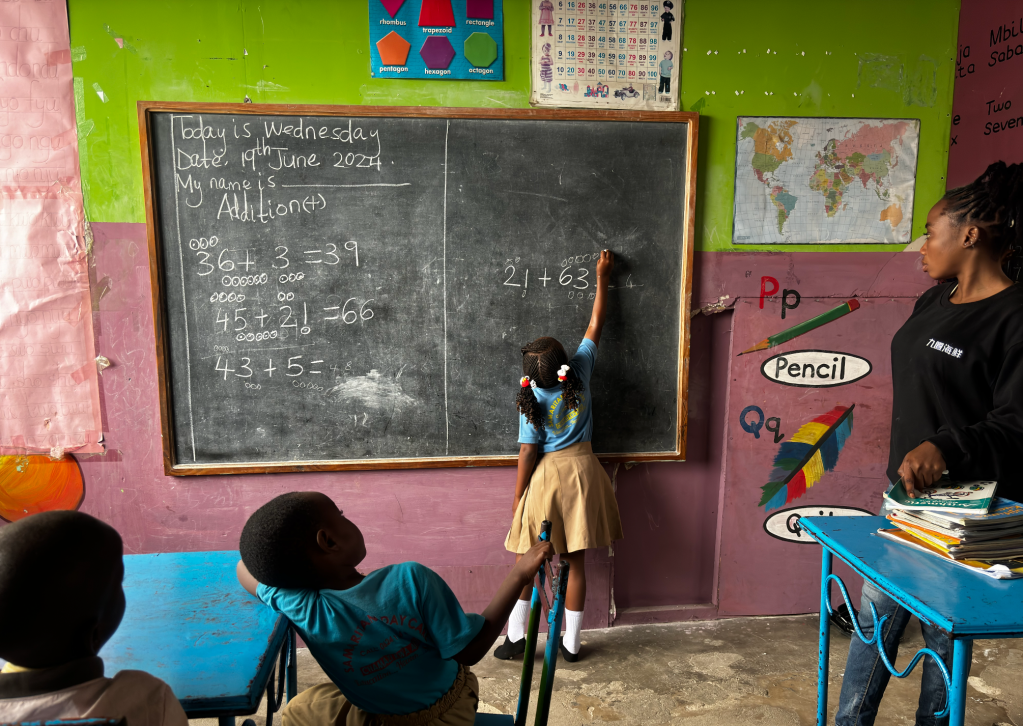
staff, giving life to the Samaritan Education Center: a kindergarten in the morning and a school in
the afternoon to support around 100 children from low-income families. Of these, 55 benefit from a
scholarship program that provides food, clothing, and supplies. “Chamazi, like much of Tanzania,
suffers from a chronic lack of educational resources,” Emmanuel explained. “In most classrooms,
there can be up to 150 students per teacher, with not enough desks or supplies for all.” His
organisation aims to make education accessible to all while developing the community by creating
jobs and teaching new skills. “It’s a project that represents the future; we’re not just helping…,” he
explained while gesturing to the children playing in the schoolyard, “…we’re growing with our
community.”
I believed in the project. It was grassroots, homegrown, and perhaps most importantly, not run by
foreigners. Working closely with Emmanuel and his team, it was clear that their intentions were
pure, and I initially felt confident I had made the right choice by joining them. My conviction grew
when I learned that Samaritan Volunteers operates without external funding, relying instead on
volunteers’ modest contributions of €10 a day to keep its projects running.
However, as I watched a group of 15-year-old kids playing the teacher’s job, with no real knowledge
or skills, I began to see how perverse the volunteering industry can be.
Lacking respect or understanding of the local culture, they turned what should be a place of
learning into a playground for their egos, treating the children like props in a story about how
generous and worldly they were.
I’m not blind to my own involvement in this critique. It turns out that I, a 20-year-old white girl,
excel at many things, such as fundraising and organising donations. I was flexible, resourceful, and
enthusiastic, qualities that, on paper, seemed perfect for international aid work.
But the reality is, I shouldn’t have been there. I wasn’t a teacher, a doctor, a carpenter, a
scientist, or an engineer – people whose skills could truly contribute to sustainable, long-term
change in developing communities. Sure, I could play with kids, make them laugh, and pretend to
teach a class, but beyond that, I couldn’t offer much else.
Some might argue that’s enough, that as long as I come with an open mind and a good heart, I’ll
inspire or empower one child so much that they will, for years, think of me every morning. But as I
left Chamazi, knowing that in six months the kids wouldn’t even remember my name, I realised I
don’t want them waking up each morning thinking of me. I don’t want a bunch of kids in Tanzania
to rely on a parade of short-term volunteers for their education or to believe that change happens
as a result of expressions of caring from Western people. Even if I’m providing funds, I shouldn’t be
filling that role.
20/08/2024
Whenever I read Emmanuel’s beautiful messages thanking me for the help, it makes me question
my own critique. Maybe my contribution did matter. Maybe the funds I raised were crucial.
Without volunteers, Samaritan Volunteers would lack the necessary funds, so who am I to
discourage others from doing the same? As someone who promised to continue supporting their
work, I wonder: Is this article itself a contradiction? I don’t want to deter support for the
community I came to care for, but I became aware that something was not the way I thought it was,
and I can’t ignore the industry’s flaws.
So, here’s a short and incomplete list of reflections on this experience that might also help you for
your next volunteering trip:
Participating in international aid without the right skills can and will be harmful.
Our presence is not the gift we’ve been led to believe by nonprofits and documentaries. A shortterm
volunteering trip often carries little more than donations and privilege thousands of miles
away, creating an almost inevitable imbalance in the give-and-take relationship.
Volunteering is largely about privilege, but privilege isn’t always an asset.
Volunteering can be fueled by noble feelings, but when we, unqualified volunteers, put ourselves
into complex situations, the voluntourism industry perpetuates a colonial mindset, one that casts
Westerners as heroes coming to “save” the poor. This isn’t just ineffective; it’s a continuation of a
harmful narrative that prevents these communities from thriving on their own terms.
To believe that volunteering is a means to own up to our privilege and that our
good intentions alone are enough is misguided.
Take, for example, the work we did in Tanzania. The Samaritan Project was in desperate need of
funding and supplies, and the program we were part of helped provide that. The children,
overwhelmed by a lack of teachers, loved having more adults around to play with them and give
them attention. It wasn’t the work that was bad; it was the fact that we were the ones doing it.
Using our funds to hire local workers would have been more cost-effective, beneficial to the local
economy, and efficient for the organisation. Instead, there we were, trying to teach a language that
we were still learning, failing at the sole purpose of our being there. Hence, point 4:
To think that the only way to help is to volunteer ignores the chance to support
economies through ethical tourism.
Travel as much as you can, experience different cultures, and get involved with communities, but
do so in a way that is culturally aware and economically invests in the places you care about and
want to see flourish. Ultimately, it’s not about whether you had a great adventure; it’s about
whether the community you touched is better off for it.
Lastly, before committing to a volunteering trip, ask yourself: Am I really helping,
or am I just looking for an adventure that makes me feel good? Do I truly have the
skills needed, or am I just another unqualified tourist in disguise?
If the answer is yes, awesome. If not, it may be wise to reconsider your plans. It’s only through an
understanding of the structural issues behind the volunteering industry that effective aid can be
provided.

 The Grad Media
Leave a comment